Digestive System Quiz
88 multiple-choice questions with answers and explanations
Test yourself on the digestive system: the layers of the gut wall and how digestion is controlled, the mouth and swallowing, the stomach, the small and large intestine, the liver, pancreas and bile ducts, and how carbohydrates, proteins and fats are digested and absorbed.
Read a question, pick an option, then open the answer to check yourself and read why it is correct.
Tract and gut wall
Question 1
Which sequence lists the gut wall layers from the lumen outward?
Show answer
Answer: A. Mucosa, submucosa, muscularis, serosa
The mucosa faces the lumen, followed by the submucosa, muscularis, and outer serosa.
Question 2
Which gut wall component immediately beneath the epithelium contains loose connective tissue and clusters of lymphocytes?
Show answer
Answer: A. Lamina propria
The lamina propria supports the epithelium and contains lymphocytes that help defend against pathogens.
Question 3
Which epithelial type primarily lines the stomach and intestines?
Show answer
Answer: C. Simple columnar epithelium
Simple columnar epithelium lines these regions of the tract.
Question 4
Which gut wall layer connects the mucosa to the muscularis and contains larger blood and lymphatic vessels?
Show answer
Answer: D. Submucosa
The submucosa is a connective tissue layer linking the mucosa to the muscularis.
Question 5
What is the arrangement of the two smooth muscle layers in the small intestinal muscularis?
Show answer
Answer: A. Inner circular and outer longitudinal
The circular layer lies inside the longitudinal layer in the small intestine.
Question 6
Which outer covering anchors the esophagus near the vertebral column?
Show answer
Answer: B. Adventitia
The esophagus has an adventitia, a collagenous sheath that helps hold it in place.
Question 7
Which function is primarily associated with the submucosal plexus?
Show answer
Answer: D. Regulating digestive secretions in response to food
The submucosal plexus regulates secretions and responds to food in the tract.
Question 8
Which peritoneal region lines the abdominal wall?
Show answer
Answer: D. Parietal peritoneum
Parietal peritoneum lines the body wall, while visceral peritoneum covers abdominal organs.
Question 9
What is the main role of the small amount of fluid in the peritoneal cavity?
Show answer
Answer: B. Reduce friction between peritoneal surfaces
The fluid lubricates the opposing serosal surfaces as the organs move.
Question 10
Which peritoneal fold has an apron-like position superficial to the small intestine and transverse colon?
Show answer
Answer: B. Greater omentum
The greater omentum hangs over these intestinal regions and can be a site of fat deposition.
Question 11
A perforated stomach ulcer allows gastric contents into the peritoneal cavity. What inflammation can follow?
Show answer
Answer: C. Peritonitis
Leaking gastric contents can inflame the peritoneum, producing peritonitis.
Digestive processes and control
Question 12
Which digestive activity specifically means taking food into the alimentary canal through the mouth?
Show answer
Answer: D. Ingestion
Ingestion is the entry of food into the tract.
Question 13
Alternating waves of gut wall contraction and relaxation move a bolus forward. Which process is occurring?
Show answer
Answer: A. Peristalsis
Peristalsis propels food along the digestive tract through sequential muscular waves.
Question 14
Why does chewing help subsequent digestion even before enzymes act?
Show answer
Answer: A. It increases the surface area of food
Breaking food into smaller pieces exposes more surface to digestive secretions.
Question 15
Which description best distinguishes mechanical digestion from chemical digestion?
Show answer
Answer: C. Physical breakdown without changing food's chemical nature
Mechanical digestion changes the size and physical form of food without changing its chemical nature.
Question 16
Localized circular muscle contractions move small intestinal contents back and forth. What is this called?
Show answer
Answer: D. Segmentation
Segmentation mixes contents and brings them into contact with digestive juices and the absorptive lining.
Question 17
Which process moves digested nutrients from the gut lumen through the epithelium into the body?
Show answer
Answer: A. Absorption
Absorption transfers nutrients across the intestinal lining so the body can use them.
Question 18
Which digestive process removes undigested material as feces?
Show answer
Answer: B. Defecation
Defecation is the final removal of undigested material from the digestive tract.
Question 19
Which receptor category detects stretching of the digestive tract wall?
Show answer
Answer: C. Mechanoreceptors
Mechanoreceptors detect mechanical stimuli, including distention caused by food.
Question 20
The sight and smell of food trigger stomach secretions before eating. Which type of reflex is responsible?
Show answer
Answer: D. Long reflex involving the central nervous system
Sensory signals about food reach the brain and initiate a long reflex that prepares the stomach.
Question 21
Which stomach hormone stimulates acid secretion by parietal cells?
Show answer
Answer: A. Gastrin
Gastrin promotes secretion of gastric acid by the stomach's parietal cells.
Question 22
Which duodenal hormone stimulates a watery, bicarbonate-rich secretion from the pancreas?
Show answer
Answer: B. Secretin
Secretin stimulates pancreatic bicarbonate secretion, helping provide suitable conditions for intestinal digestion.
Mouth and swallowing
Question 23
What is the name of the pocket between the cheeks and lips externally and the teeth and gums internally?
Show answer
Answer: C. Oral vestibule
The oral vestibule is the space outside the teeth and gums but inside the lips and cheeks.
Question 24
Which tongue structures provide an abrasive surface and touch information that help manipulate food?
Show answer
Answer: B. Filiform papillae
Filiform papillae provide a rough mechanical surface and touch information for moving food.
Question 25
Which salivary glands deliver their secretion through ducts near the second upper molars?
Show answer
Answer: C. Parotid glands
The parotid ducts open near the second upper molar teeth.
Question 26
Which statement correctly describes secretion by the major salivary glands?
Show answer
Answer: B. Sublingual glands produce the thickest saliva with the least amylase
Sublingual glands contain mostly mucus-secreting cells, so their saliva is thick and relatively low in amylase.
Question 27
Which salivary component prevents microbes from penetrating the oral epithelium?
Show answer
Answer: C. Immunoglobulin A
Salivary immunoglobulin A helps prevent microbial entry through the epithelium.
Question 28
Which teeth have pointed cusps specialized for piercing and tearing food?
Show answer
Answer: D. Canines
Canines, also called cuspids, have pointed edges useful for tearing tough food.
Question 29
Which tissue covers the dentin in the root of a tooth?
Show answer
Answer: A. Cementum
Cementum covers root dentin, whereas enamel covers dentin in the crown.
Question 30
What mechanism causes enamel damage in dental caries as described by OpenStax?
Show answer
Answer: D. Acid release by bacteria feeding on sugars
Bacteria metabolizing sugars release acids that damage enamel crystals.
Question 31
Which sequence gives the phases of swallowing in order?
Show answer
Answer: C. Voluntary, pharyngeal, esophageal
Swallowing begins with a voluntary oral phase, followed by the involuntary pharyngeal and esophageal phases.
Question 32
Which sphincter failing to close completely can allow gastric contents to reflux into the esophagus?
Show answer
Answer: D. Lower esophageal sphincter
Incomplete closure of the lower esophageal sphincter permits reflux and can cause heartburn.
Question 33
What is the muscle composition of the esophageal muscularis in its middle third?
Show answer
Answer: A. Skeletal and smooth muscle
The esophageal muscularis transitions from skeletal muscle above to smooth muscle below, with a mixture in the middle.
Stomach
Question 34
Which dome-shaped stomach region lies above and to the left of the cardia?
Show answer
Answer: B. Fundus
The fundus forms the dome superior and lateral to the cardia.
Question 35
Which sphincter controls the release of stomach contents into the duodenum?
Show answer
Answer: C. Pyloric sphincter
The pyloric sphincter regulates stomach emptying at the connection to the duodenum.
Question 36
Where is the additional oblique smooth muscle layer of the stomach located?
Show answer
Answer: B. Deep to the circular muscle layer
An inner oblique smooth muscle layer supplements the circular and longitudinal layers.
Question 37
Which gastric gland cells produce both hydrochloric acid and intrinsic factor?
Show answer
Answer: A. Parietal cells
Parietal cells secrete acid for digestion and intrinsic factor for vitamin B12 absorption.
Question 38
Which inactive enzyme precursor is secreted by gastric chief cells?
Show answer
Answer: B. Pepsinogen
Chief cells release pepsinogen, which is converted to the protein-digesting enzyme pepsin.
Question 39
A student thinks about a favorite meal and gastric secretion rises before food reaches the stomach. Which phase is this?
Show answer
Answer: C. Cephalic phase
Thoughts and sensory cues about food trigger the cephalic phase before food enters the stomach.
Question 40
What effect does the enterogastric reflex have when the duodenum becomes distended with chyme?
Show answer
Answer: A. It inhibits gastric secretion and closes the pyloric sphincter
This reflex limits additional delivery of chyme while the duodenum processes its contents.
Question 41
How does bicarbonate-rich mucus help protect the stomach lining?
Show answer
Answer: A. It forms a barrier and neutralizes acid
Mucus provides a physical shield, and its bicarbonate neutralizes acid near the lining.
Question 42
According to OpenStax, which pair accounts for the majority of stomach ulcers?
Show answer
Answer: A. Excessive NSAID intake and Helicobacter pylori infection
OpenStax identifies excessive NSAID intake and Helicobacter pylori infection as the principal causes of ulcers in its discussion of breakdown of the stomach mucosal barrier.
Question 43
What happens to salivary amylase and lingual lipase when food mixes with acidic gastric chyme?
Show answer
Answer: D. Salivary amylase is inactivated, and lingual lipase is activated
Acidic gastric chyme inactivates salivary amylase and activates lingual lipase.
Question 44
Which meal composition tends to remain in the stomach the longest?
Show answer
Answer: D. High triglyceride content
Fat-rich meals empty more slowly because the small intestine processes fats slowly.
Small intestine
Question 45
Which sequence gives the small intestinal regions from the stomach toward the large intestine?
Show answer
Answer: A. Duodenum, jejunum, ileum
Chyme passes through the duodenum, then the jejunum, and finally the ileum.
Question 46
Which region of the alimentary canal curves around the head of the pancreas?
Show answer
Answer: B. Duodenum
The duodenum forms a C-shaped curve around the pancreatic head.
Question 47
Where do the bile duct and main pancreatic duct join before their contents enter the duodenum?
Show answer
Answer: C. Hepatopancreatic ampulla
The ducts meet in the hepatopancreatic ampulla in the duodenal wall.
Question 48
What is the effect of the circular folds on the movement of chyme?
Show answer
Answer: B. They cause spiraling that slows transit
Circular folds make chyme spiral, giving more time for absorption.
Question 49
Which description identifies intestinal microvilli rather than villi?
Show answer
Answer: A. Apical plasma membrane extensions of epithelial cells
Microvilli are extensions of individual epithelial cell membranes and collectively form the brush border.
Question 50
Where are enzymes that finish carbohydrate and protein digestion attached?
Show answer
Answer: C. Microvillus membranes
Brush border enzymes are fixed to the membranes of the microvilli.
Question 51
Which glands secrete bicarbonate-rich alkaline mucus that buffers chyme as it enters the small intestine?
Show answer
Answer: A. Brunner's glands
Brunner's (duodenal) glands lie in the duodenal submucosa and secrete alkaline mucus that helps neutralize acidic chyme.
Question 52
Where are Peyer's patches concentrated in the small intestine?
Show answer
Answer: D. Distal ileum
These aggregates of lymphoid tissue are concentrated in the distal ileum and help prevent bacterial entry into blood.
Question 53
Which hormone initiates migrating motility complexes in the small intestine?
Show answer
Answer: A. Motilin
Motilin initiates the peristaltic transport pattern that replaces localized segmentation as distention decreases.
Question 54
Why could a large, sudden load of hypertonic gastric chyme threaten blood volume?
Show answer
Answer: B. It draws water from blood into the intestinal lumen
Hypertonic chyme can pull water into the intestine by osmosis, reducing blood volume.
Question 55
A person lacks sufficient intestinal lactase and develops gas after drinking milk. What produces much of that gas?
Show answer
Answer: C. Bacterial fermentation of undigested lactose in the colon
Undigested lactose reaches colonic bacteria, which ferment it and produce gas.
Large intestine
Question 56
Which large intestinal region first receives contents from the ileum?
Show answer
Answer: D. Cecum
The ileum empties through the ileocecal valve into the cecum.
Question 57
After residue passes through the ascending colon and rounds the right colic flexure, which segment does it enter?
Show answer
Answer: A. Transverse colon
At the right colic flexure, also called the hepatic flexure, the ascending colon becomes the transverse colon.
Question 58
Which colonic bend is immediately inferior to the spleen?
Show answer
Answer: B. Left colic flexure
The left colic, or splenic, flexure is the turn from the transverse to descending colon.
Question 59
Which sphincter permits voluntary control because it consists of skeletal muscle?
Show answer
Answer: C. External anal sphincter
The external anal sphincter is skeletal muscle under voluntary control.
Question 60
Which surface features found in the small intestine are absent from the large intestine?
Show answer
Answer: D. Circular folds and villi
The large intestine lacks the circular folds and villi characteristic of the small intestine.
Question 61
What creates the pouches called haustra in the colon?
Show answer
Answer: B. Tonic contractions of the teniae coli
The teniae coli bunch the colon wall into a series of haustra.
Question 62
What do goblet cell secretions do in the colon?
Show answer
Answer: B. Lubricate feces and protect the lining
Goblet cells release mucus that helps feces move and protects the lining from bacterial products.
Question 63
What performs chemical digestion in the lumen of the large intestine?
Show answer
Answer: C. Resident bacteria
Colonic glands do not secrete digestive enzymes, so bacteria carry out chemical digestion there.
Question 64
Which colonic movement rapidly forces contents toward the rectum?
Show answer
Answer: D. Mass movement
Mass movements are strong waves that drive colonic contents toward the rectum.
Question 65
Which stimulus initiates the defecation reflex?
Show answer
Answer: A. Stretching of the rectal wall by feces
Fecal entry distends the rectum and triggers the defecation reflex.
Question 66
Why can repeatedly delaying defecation lead to firmer feces?
Show answer
Answer: B. Additional water is absorbed from retained feces
Longer retention permits more water absorption, making stool harder and potentially causing constipation.
Liver, pancreas and bile ducts
Question 67
Which set of structures makes up a portal triad?
Show answer
Answer: C. Bile duct, hepatic artery branch, hepatic portal vein branch
A portal triad contains branches that bring blood into a lobule and carry bile away.
Question 68
Which small channels collect bile directly from adjacent hepatocytes?
Show answer
Answer: D. Bile canaliculi
Grooves between neighboring hepatocytes form bile canaliculi, which collect their bile.
Question 69
Where does blood from hepatic sinusoids drain next?
Show answer
Answer: B. Central vein
Sinusoidal blood converges on the central vein before leaving through hepatic veins.
Question 70
How do blood and bile flow relative to each other within liver lobules?
Show answer
Answer: B. In opposite directions
Blood drains toward central veins, while bile moves through canaliculi toward bile ducts.
Question 71
Which liver cells remove bacteria and dead blood cells from sinusoidal blood?
Show answer
Answer: C. Reticuloendothelial cells
Sinusoidal reticuloendothelial cells are phagocytes that remove cellular debris and foreign material.
Question 72
The common hepatic duct joins which duct to form the common bile duct?
Show answer
Answer: D. Cystic duct
The cystic duct connects the gallbladder to the common hepatic duct, forming the common bile duct.
Question 73
What is the main route by which bile salts return to the liver for reuse?
Show answer
Answer: D. Absorption in the ileum followed by transport in hepatic portal blood
Enterohepatic circulation returns absorbed bile salts from the ileum to the liver.
Question 74
Which pancreatic cells secrete enzyme-rich digestive juice into ducts?
Show answer
Answer: B. Acinar cells
The exocrine acinar cells release digestive juice into ducts, unlike endocrine islet cells.
Question 75
Where are pancreatic protein-digesting enzyme precursors normally activated?
Show answer
Answer: C. In the duodenum
Inactive precursors protect pancreatic tissue until the enzymes are activated in the duodenum.
Question 76
Which brush border enzyme initiates activation of pancreatic trypsinogen?
Show answer
Answer: D. Enteropeptidase
Enteropeptidase activates trypsinogen to trypsin, which can then activate other pancreatic protease precursors.
Question 77
How does the gallbladder concentrate bile?
Show answer
Answer: B. Its mucosa absorbs water and ions
Removal of water and ions by the gallbladder mucosa concentrates the stored bile.
Chemical digestion and absorption
Question 78
Which chemical reaction do digestive enzymes use to split large food molecules into absorbable subunits?
Show answer
Answer: B. Hydrolysis
Enzymatic hydrolysis breaks large food molecules into smaller subunits for absorption.
Question 79
Sucrase splits sucrose into which monosaccharides?
Show answer
Answer: C. Glucose and fructose
Sucrase produces one glucose molecule and one fructose molecule from sucrose.
Question 80
Which products are the main result of pancreatic lipase digestion of one triglyceride?
Show answer
Answer: A. Two free fatty acids and a monoglyceride
Pancreatic lipase removes two fatty acids, leaving a monoglyceride.
Question 81
Which pancreatic enzyme digests RNA?
Show answer
Answer: A. Ribonuclease
Ribonuclease digests RNA, while deoxyribonuclease digests DNA.
Question 82
Which sugar enters intestinal epithelial cells by facilitated diffusion rather than sodium-linked cotransport?
Show answer
Answer: B. Fructose
Fructose uses facilitated diffusion, whereas glucose and galactose enter epithelial cells by sodium-linked cotransport.
Question 83
How are dipeptides and tripeptides normally handled during intestinal absorption?
Show answer
Answer: B. They are broken down into amino acids inside absorptive epithelial cells
Small peptides enter absorptive cells, where they are split into amino acids before entering blood.
Question 84
What is the main role of micelles during lipid absorption?
Show answer
Answer: C. Bring hydrophobic lipid digestion products close to the absorptive cell surface
Micelles keep hydrophobic lipid products suspended and bring them close to epithelial cells for diffusion into the cells.
Question 85
Why do chylomicrons enter lacteals rather than blood capillaries in intestinal villi?
Show answer
Answer: A. They are too large to cross blood capillary basement membranes
Lacteals have large pores that admit chylomicrons, which are too large for blood capillary basement membranes.
Question 86
Which protein binds ionic iron inside intestinal mucosal cells for storage?
Show answer
Answer: B. Ferritin
Iron binds ferritin inside mucosal cells, forming stored iron-ferritin complexes.
Question 87
Which group of vitamins is absorbed with dietary lipids in micelles?
Show answer
Answer: C. A, D, E, and K
The fat-soluble vitamins A, D, E, and K accompany lipids during micellar absorption.
Question 88
Where is the intrinsic factor-vitamin B12 complex taken up by endocytosis?
Show answer
Answer: C. Terminal ileum
The complex binds receptors in the terminal ileum and enters the mucosal cells by endocytosis.
Digestive System labeled diagrams
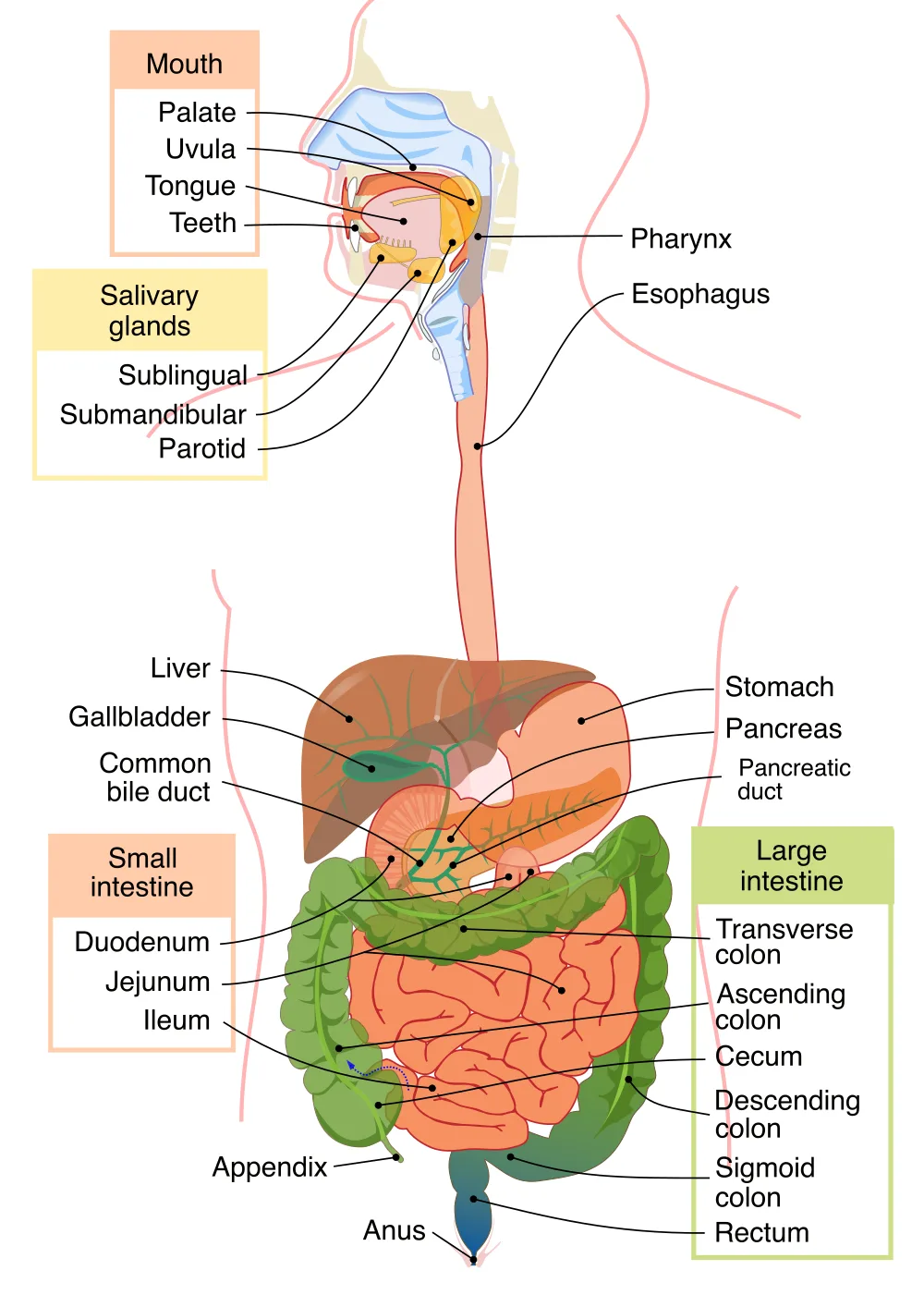
The digestive system and its accessory organs.
Labeled: palate, uvula, tongue, teeth, sublingual, submandibular and parotid salivary glands, pharynx, esophagus, stomach, liver, gallbladder, common bile duct, pancreas, pancreatic duct, duodenum, jejunum, ileum, cecum, appendix, ascending, transverse, descending and sigmoid colon, rectum, anus.
Image: Digestive system diagram en.svg by Mariana Ruiz (LadyofHats), Jmarchn, Public domain. Rendered from SVG on a white background at 1000 px wide and converted to WebP. Click the image to open it full size.
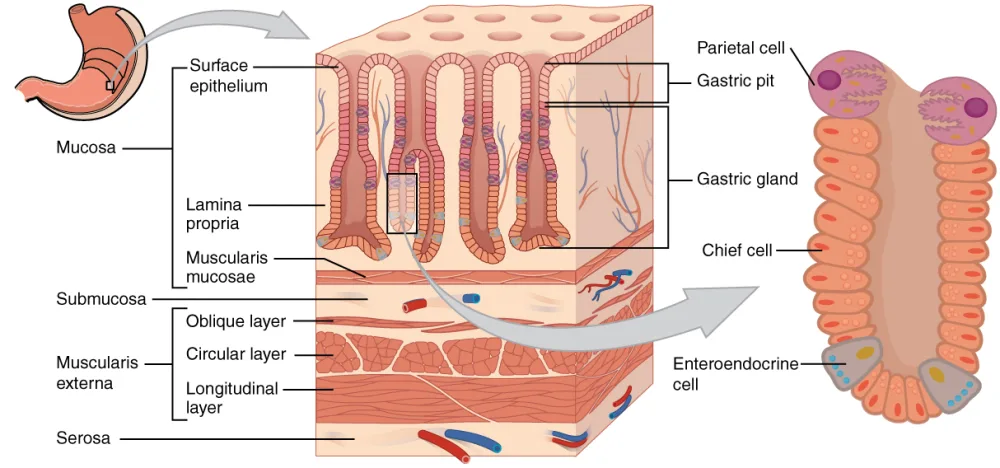
Layers of the stomach wall and the cells of a gastric gland.
Labeled: mucosa: surface epithelium, lamina propria, muscularis mucosae, submucosa, muscularis externa: oblique, circular and longitudinal layers, serosa, gastric pit, gastric gland, parietal cell, chief cell, enteroendocrine cell.
Image: 2415 Histology of StomachN.jpg by OpenStax College, CC BY 3.0. Resized to 1000 px wide and converted to WebP. Click the image to open it full size.
About these questions
The questions were written with AI in the format PDFStudy produces, then checked question by question against OpenStax Anatomy and Physiology 2e, a free peer-reviewed textbook: wrong or ambiguous items were corrected or removed, and repeats were dropped. Last reviewed 2026-10-20. Found a mistake? Tell us and we will fix it.
Studying from your own lecture slides or textbook? Upload the PDF and PDFStudy turns it into a quiz like this one, which you can also export to Anki.