Anatomy and Physiology Quiz
107 multiple-choice questions with answers and explanations
A general anatomy and physiology quiz for the start of a course or a quick review: anatomical position, body planes and directional terms, levels of organization, homeostasis, cells and tissues, and the main organ systems.
Read a question, pick an option, then open the answer to check yourself and read why it is correct.
Anatomical terms, position and body planes
Question 1
Which plane divides the body into anterior and posterior sections?
Show answer
Answer: A. Coronal
The coronal (or frontal) plane divides the body into front (anterior) and back (posterior) sections. It's commonly used in medical imaging and anatomical reference.
Question 2
What anatomical term means 'away from the point of attachment'?
Show answer
Answer: C. Distal
Distal refers to a structure that is farther from the trunk or the point of origin, often used in limb anatomy.
Question 3
Which of these body cavities lies inferior to the diaphragm?
Show answer
Answer: D. Abdominal cavity
The abdominal cavity lies below the diaphragm and contains digestive organs like the stomach and intestines.
Question 4
What directional term means 'toward the midline of the body'?
Show answer
Answer: D. Medial
Medial means closer to the midline of the body. In contrast, lateral refers to being farther away from the midline.
Question 5
Identify the term that describes the study of body structure
Show answer
Answer: A. Anatomy
Anatomy focuses on the form and structure of body parts, including their locations, shapes, and relationships to one another.
Question 6
What term describes the front surface of the body?
Show answer
Answer: D. Anterior
Anterior refers to the front side of the body. It is often used in contrast with posterior, which means the back side.
Question 7
Which plane divides the body vertically into right and left portions?
Show answer
Answer: D. Sagittal
The sagittal plane divides the body into right and left portions. If it is exactly in the middle, it's called the midsagittal plane.
Question 8
Which organ is found in the thoracic cavity?
Show answer
Answer: C. Lung
The thoracic cavity houses the lungs and heart. It is located above the diaphragm.
Question 9
What term is used to describe a structure closer to the point of attachment?
Show answer
Answer: A. Proximal
Proximal refers to a body part that is closer to the trunk or point of origin, often used to describe parts of the limbs.
Question 10
Which body cavity contains the brain?
Show answer
Answer: B. Cranial cavity
The cranial cavity is the space within the skull that houses the brain.
Question 11
What term describes the position of the heart relative to the lungs?
Show answer
Answer: D. Medial
The heart lies medial to the lungs, meaning it is closer to the midline of the body.
Question 12
Which directional term means 'toward the surface of the body'?
Show answer
Answer: B. Superficial
Superficial means closer to or on the surface of the body, while deep refers to structures further inside the body.
Question 13
Which anatomical term describes a position behind or toward the back of the body?
Show answer
Answer: C. Posterior
Posterior means toward the back of the body. It is the opposite of anterior.
Question 14
Which cavity contains the reproductive organs in females?
Show answer
Answer: B. Pelvic cavity
The pelvic cavity holds reproductive organs, the bladder, and parts of the intestines in both males and females.
Question 15
Which of these is the correct anatomical position?
Show answer
Answer: A. Standing upright, arms at sides, palms facing forward
The anatomical position is a standardized stance: body upright, facing forward, arms at the sides with palms facing forward.
Question 16
Which directional term means 'closer to the feet'?
Show answer
Answer: D. Inferior
Inferior refers to a position lower on the body, or closer to the feet.
Question 17
Which term describes a structure farther from the midline of the body?
Show answer
Answer: A. Lateral
Lateral means away from the midline of the body, as opposed to medial, which means toward the midline.
Question 18
What structure separates the thoracic and abdominal cavities?
Show answer
Answer: D. Diaphragm
The diaphragm is a dome-shaped muscle that separates the thoracic and abdominal cavities and plays a role in breathing.
Question 19
Which directional term means 'toward the head'?
Show answer
Answer: B. Superior
Superior means a position above or higher than another part of the body, typically toward the head.
Levels of organization and homeostasis
Question 20
Which term best describes all the chemical processes that occur within the cells of the body?
Show answer
Answer: A. Metabolism
Metabolism includes all the chemical reactions that take place within a living organism to maintain life. It involves both building up molecules (anabolism) and breaking them down (catabolism).
Question 21
Identify the term that refers to the body's ability to maintain a stable internal environment
Show answer
Answer: D. Homeostasis
Homeostasis is the process by which the body regulates internal conditions like temperature and pH to keep them within a narrow, stable range despite external changes.
Question 22
What is the smallest functional unit of life?
Show answer
Answer: C. Cell
The cell is the basic structural, functional, and biological unit of all living organisms.
Question 23
What part of a feedback loop carries out the response to a stimulus?
Show answer
Answer: D. Effector
Effectors carry out responses to signals from the control center. Their responses oppose the initial change in negative feedback and amplify it in positive feedback.
Question 24
What term refers to the chemical processes that build up molecules in the body?
Show answer
Answer: C. Anabolism
Anabolism refers to metabolic pathways that construct molecules from smaller units, often requiring energy.
Question 25
Which term refers to the body's ability to break down substances for energy?
Show answer
Answer: A. Catabolism
Catabolism involves the breakdown of complex molecules into simpler ones, releasing energy that the body can use.
Question 26
Which part of a feedback loop detects a change in the internal environment?
Show answer
Answer: D. Receptor
The receptor detects changes or stimuli in the environment and sends information to the control center.
Question 27
What term describes a group of organs working together for a common function?
Show answer
Answer: C. Organ system
An organ system is made of multiple organs that collaborate to carry out a major body function, such as digestion or circulation.
Question 28
What is the name for a group of similar cells that perform a specific function?
Show answer
Answer: C. Tissue
A tissue is a group of similar cells working together to perform a specific function, such as muscle tissue or epithelial tissue.
Question 29
Which level of organization comes after tissues?
Show answer
Answer: D. Organ
An organ is formed from multiple tissue types working together to perform a specific function, such as the heart or liver.
Cells, tissues and blood
Question 30
What is the main function of red blood cells?
Show answer
Answer: B. Transport oxygen
Red blood cells contain hemoglobin, which binds to oxygen and transports it to tissues throughout the body.
Question 31
What type of connective tissue cushions joints and provides flexible support?
Show answer
Answer: C. Cartilage
Cartilage is a smooth, rubbery tissue that cushions joints and supports structures like the nose and ears.
Question 32
Which blood cell fragments aggregate at an injured vessel to help limit blood loss?
Show answer
Answer: B. Platelets
Platelets adhere and aggregate at an injured vessel to form a platelet plug, helping limit blood loss.
Question 33
What is the function of white blood cells?
Show answer
Answer: A. Fight infection
White blood cells are part of the immune system and help the body fight infections and other diseases.
Question 34
What is the general category of membrane transport that does not require expenditure of cellular energy?
Show answer
Answer: B. Passive transport
Passive transport moves substances across a membrane without requiring the cell to expend metabolic energy. It includes simple diffusion, facilitated diffusion, and osmosis.
Question 35
Which type of tissue allows for rapid communication and control of body functions?
Show answer
Answer: D. Nervous tissue
Nervous tissue transmits electrical impulses, enabling quick communication throughout the body.
Question 36
Which tissue type covers body surfaces and lines organs?
Show answer
Answer: A. Epithelial tissue
Epithelial tissue forms protective layers on surfaces and lines cavities and hollow organs.
Question 37
Which blood type is considered the universal red blood cell donor in the ABO and RhD systems?
Show answer
Answer: B. O negative
O negative red blood cells lack A, B, and RhD antigens. Other blood-group antigens can still affect compatibility, so appropriate compatibility testing remains necessary.
Question 38
What organelle in cells is known as the powerhouse due to energy production?
Show answer
Answer: A. Mitochondrion
Mitochondria generate ATP through cellular respiration, providing energy for cell functions.
Question 39
Which organelle contains most of the DNA in a typical nucleated human cell?
Show answer
Answer: A. Nucleus
Most cellular DNA is in the nucleus, where it stores genetic instructions. A small amount of DNA is also present in mitochondria.
Question 40
Which structure protects the ends of chromosomes from deterioration?
Show answer
Answer: D. Telomere
Telomeres are repetitive sequences at chromosome ends that prevent loss of genetic data during cell division.
Question 41
Which white blood cells are primarily responsible for producing antibodies?
Show answer
Answer: C. B lymphocytes
Activated B lymphocytes can differentiate into plasma cells, which secrete antibodies that bind specific antigens.
Question 42
Which vitamin is essential for blood clotting?
Show answer
Answer: A. Vitamin K
Vitamin K plays a crucial role in the synthesis of clotting factors needed to stop bleeding.
Skin, bones and muscles
Question 43
Which organ system forms the bony framework that supports the body and protects internal organs?
Show answer
Answer: C. Skeletal system
The skeletal system includes bones and cartilage that support the body and protect internal organs.
Question 44
Which organ system includes the skin, hair, and nails?
Show answer
Answer: B. Integumentary system
The integumentary system consists of the skin and its associated structures. It protects the body and helps regulate temperature.
Question 45
Which type of muscle tissue forms the muscular walls of the intestines and urinary bladder?
Show answer
Answer: C. Smooth muscle
Smooth muscle is involuntary and is found in the walls of hollow organs like the intestines and blood vessels.
Question 46
Which type of muscle tissue is involuntary and only found in the heart?
Show answer
Answer: B. Cardiac muscle
Cardiac muscle is a specialized, involuntary muscle found only in the heart, responsible for pumping blood.
Question 47
What is the outermost layer of the skin called?
Show answer
Answer: D. Epidermis
The epidermis is the thin, outermost layer of the skin that provides a protective barrier.
Question 48
What is the largest organ in the human body?
Show answer
Answer: A. Skin
The skin is the largest organ of the body and forms a protective barrier against the external environment.
Question 49
Which part of the skeleton includes the skull, vertebral column, and rib cage?
Show answer
Answer: A. Axial skeleton
The axial skeleton consists of the bones that form the central axis of the body: skull, spine, and rib cage.
Question 50
Which process replaces a hyaline cartilage model with bone?
Show answer
Answer: A. Endochondral ossification
Endochondral ossification replaces a hyaline cartilage model with bone. Intramembranous ossification forms bone directly in mesenchymal connective tissue.
Question 51
What is the tough connective tissue that covers the outside of a bone called?
Show answer
Answer: C. Periosteum
The periosteum is a dense membrane covering bones, providing nourishment and serving as an attachment point for tendons and ligaments.
Question 52
Which layer of the skin lies directly beneath the epidermis and contains blood vessels and nerves?
Show answer
Answer: B. Dermis
The dermis lies beneath the epidermis and contains blood vessels, nerve endings, and connective tissue.
Question 53
What is the name of the bone that forms the forehead?
Show answer
Answer: B. Frontal bone
The frontal bone forms the forehead and part of the upper eye sockets.
Question 54
Which muscle is the most superficial and visible muscle of the calf?
Show answer
Answer: C. Gastrocnemius
The gastrocnemius lies superficial to the soleus and helps plantarflex the foot and flex the knee.
Question 55
Which structure in the skin is responsible for producing sweat?
Show answer
Answer: A. Sudoriferous gland
Sudoriferous glands produce sweat. Eccrine glands release sweat onto the skin surface for cooling, whereas apocrine glands usually empty into hair follicles.
Question 56
What is the name of the pigment responsible for skin color?
Show answer
Answer: C. Melanin
Melanin is produced by melanocytes and determines the color of skin, hair, and eyes.
Question 57
Which muscle group is found on the front of the thigh?
Show answer
Answer: C. Quadriceps
The quadriceps are a group of four muscles at the front of the thigh responsible for extending the knee.
Question 58
Which bony structure encloses and protects the brain?
Show answer
Answer: C. Cranium
The braincase is formed by eight cranial bones that enclose and protect the brain.
Nervous and endocrine systems
Question 59
What is the name of the system that controls body activities with electrical signals?
Show answer
Answer: B. Nervous system
The nervous system uses electrical impulses to control body functions and respond to stimuli.
Question 60
Which body system includes glands such as the thyroid and adrenal glands?
Show answer
Answer: D. Endocrine system
The endocrine system is made up of glands that secrete hormones directly into the bloodstream to regulate body functions.
Question 61
Which structure in the human body produces insulin?
Show answer
Answer: D. Pancreas
The pancreas is both an exocrine and endocrine gland and produces insulin to help regulate blood glucose levels.
Question 62
Which part of the eye controls the amount of light that enters?
Show answer
Answer: D. Iris
The iris adjusts the size of the pupil to control how much light enters the eye.
Question 63
Which system is responsible for controlling growth and metabolism?
Show answer
Answer: C. Endocrine system
The endocrine system releases hormones that regulate growth, metabolism, and other vital functions.
Question 64
Which structure of the ear helps maintain balance?
Show answer
Answer: A. Semicircular canals
Receptors in the semicircular ducts detect rotational head movement and contribute to balance. The utricle and saccule detect linear acceleration and head orientation relative to gravity.
Question 65
Which structure in the vertebral canal carries signals between the brain and the trunk and limbs?
Show answer
Answer: B. Spinal cord
The spinal cord carries ascending sensory signals toward the brain and descending motor commands toward the trunk and limbs.
Question 66
Which organ is part of the central nervous system?
Show answer
Answer: D. Brain
The central nervous system consists of the brain and spinal cord, responsible for processing information and controlling responses.
Question 67
Which hormone lowers blood glucose levels?
Show answer
Answer: C. Insulin
Insulin is produced by the pancreas and helps cells absorb glucose from the bloodstream, reducing blood sugar levels.
Question 68
What is the largest part of the human brain?
Show answer
Answer: B. Cerebrum
The cerebrum controls voluntary actions, reasoning, and senses, and is the largest brain structure.
Question 69
Which part of the ear converts sound vibrations into nerve impulses?
Show answer
Answer: D. Cochlea
The cochlea is a spiral-shaped organ in the inner ear that transforms sound into electrical signals sent to the brain.
Question 70
Which organ helps regulate blood sugar by producing glucagon?
Show answer
Answer: D. Pancreas
The pancreas produces glucagon, a hormone that raises blood sugar by signaling the liver to release glucose.
Question 71
Which hormone regulates metabolism and is produced by the thyroid gland?
Show answer
Answer: B. Thyroxine
Thyroxine, produced by the thyroid, plays a critical role in controlling the body's metabolic rate.
Question 72
Which cortical region in the frontal lobe sends commands that initiate voluntary skeletal muscle movements?
Show answer
Answer: B. Motor cortex
The motor cortex sends descending commands that initiate voluntary skeletal muscle movements.
Question 73
Which cranial nerve is responsible for vision?
Show answer
Answer: C. Optic nerve
The optic nerve (cranial nerve II) transmits visual information from the retina to the brain.
Question 74
Which part of the brain interprets sensory information like touch, temperature, and pain?
Show answer
Answer: D. Parietal lobe
The parietal lobe processes sensory input from the skin, including touch, temperature, and pain.
Heart, blood vessels and lymphatic system
Question 75
Which body system is primarily responsible for transporting nutrients and oxygen?
Show answer
Answer: D. Circulatory system
The circulatory system, including the heart and blood vessels, is responsible for transporting nutrients and oxygen throughout the body.
Question 76
Which body system helps protect against disease and returns fluid to the bloodstream?
Show answer
Answer: C. Lymphatic system
The lymphatic system plays a role in immune defense and helps maintain fluid balance by returning leaked fluid to the blood.
Question 77
Which chamber of the heart pumps oxygenated blood to the body?
Show answer
Answer: A. Left ventricle
The left ventricle pumps oxygen-rich blood through the aorta to the entire body, making it the most muscular chamber.
Question 78
Which blood vessels carry blood away from the heart?
Show answer
Answer: A. Arteries
Arteries carry blood away from the heart, regardless of its oxygen content.
Question 79
Which blood vessel carries oxygenated blood from the lungs to the heart?
Show answer
Answer: A. Pulmonary vein
The pulmonary vein carries oxygen-rich blood from the lungs to the left atrium of the heart.
Question 80
What is the name of the valve between the left atrium and left ventricle?
Show answer
Answer: D. Mitral valve
The mitral valve controls blood flow between the left atrium and the left ventricle of the heart.
Question 81
What is the term for the smallest blood vessels in the body?
Show answer
Answer: D. Capillaries
Capillaries are tiny vessels where oxygen, nutrients, and waste are exchanged between blood and tissues.
Question 82
What is the name of the largest artery in the human body?
Show answer
Answer: C. Aorta
The aorta is the largest artery in the body and carries blood from the left ventricle into the systemic circulation.
Question 83
Which part of the heart receives oxygen-poor blood from the body?
Show answer
Answer: B. Right atrium
The right atrium collects deoxygenated blood from the body before passing it to the right ventricle.
Question 84
Which structure is responsible for filtering lymph and housing immune cells?
Show answer
Answer: D. Lymph node
Lymph nodes act as filters for harmful substances and are key sites for immune cell activation.
Respiratory, digestive and urinary systems
Question 85
Which organ is part of the digestive system?
Show answer
Answer: D. Stomach
The stomach is a muscular organ involved in the digestion of food and is a central part of the digestive system.
Question 86
Which system removes wastes from the blood and excretes them in urine?
Show answer
Answer: A. Urinary system
The kidneys remove wastes from the blood and produce urine. The urinary bladder stores urine before it is excreted.
Question 87
What is the main function of the respiratory system?
Show answer
Answer: C. Gas exchange
The respiratory system allows for the exchange of oxygen and carbon dioxide between the air and the bloodstream.
Question 88
Which organ is responsible for producing bile?
Show answer
Answer: C. Liver
The liver produces bile, which helps break down fats in the digestive process. The gallbladder stores the bile.
Question 89
Which organ removes carbon dioxide from the blood?
Show answer
Answer: D. Lungs
The lungs expel carbon dioxide, a waste product of cellular respiration, during exhalation.
Question 90
Which organ in the digestive system absorbs most nutrients?
Show answer
Answer: B. Small intestine
The small intestine is the primary site for nutrient absorption during digestion.
Question 91
What is the main function of the large intestine?
Show answer
Answer: D. Absorb water
The large intestine absorbs water and forms solid waste for elimination.
Question 92
Which part of the respiratory system is the site of gas exchange?
Show answer
Answer: B. Alveoli
Alveoli are tiny air sacs in the lungs where oxygen and carbon dioxide are exchanged with the blood.
Question 93
Which organ filters blood to produce urine?
Show answer
Answer: B. Kidney
The kidneys filter waste and excess substances from the blood to produce urine.
Question 94
Which organ is part of both the respiratory and digestive systems?
Show answer
Answer: D. Pharynx
The pharynx is a shared pathway for both air and food, making it part of both the respiratory and digestive systems.
Question 95
Which part of the nephron filters blood in the kidney?
Show answer
Answer: D. Glomerulus
The glomerulus is a cluster of capillaries in the nephron where filtration of blood occurs to begin urine formation.
Question 96
What is the function of the epiglottis?
Show answer
Answer: C. Prevent food from entering the trachea
During swallowing, the epiglottis folds over the laryngeal opening, helping prevent food and liquid from entering the airway.
Question 97
Which structure carries urine from the kidneys to the bladder?
Show answer
Answer: C. Ureter
The ureters are muscular tubes that transport urine from each kidney to the bladder.
Question 98
What structure in the male reproductive system stores and matures sperm?
Show answer
Answer: A. Epididymis
The epididymis is a coiled tube on the back of the testis where sperm mature and are stored before ejaculation.
Question 99
What is the basic functional unit of the kidney?
Show answer
Answer: B. Nephron
The nephron is the structural and functional unit of the kidney responsible for filtering blood and forming urine.
Question 100
Which part of the female reproductive system is the site of fertilization?
Show answer
Answer: A. Fallopian tube
Fertilization usually occurs in the fallopian tubes, where the sperm meets the egg after ovulation.
Question 101
Which organ is primarily responsible for detoxifying chemicals in the body?
Show answer
Answer: B. Liver
The liver processes and neutralizes toxins in the blood, playing a key role in detoxification.
Question 102
Which structure in the respiratory system is also known as the voice box?
Show answer
Answer: D. Larynx
The larynx houses the vocal cords and is responsible for producing sound.
Question 103
What is the name of the tube that connects the throat to the stomach?
Show answer
Answer: B. Esophagus
The esophagus is a muscular tube that carries swallowed food from the pharynx to the stomach.
Question 104
What is the function of bile in digestion?
Show answer
Answer: D. Emulsify fats
Bile is produced by the liver and stored in the gallbladder; it helps break fats into smaller droplets for enzyme action.
Question 105
What is the classical liver unit organized around a central vein?
Show answer
Answer: C. Lobule
In the classical hepatic lobule, plates of hepatocytes radiate outward from a central vein.
Question 106
Which muscular posterior part of the roof of the mouth elevates during swallowing to help close the nasopharynx?
Show answer
Answer: D. Soft palate
The soft palate elevates together with the uvula during swallowing, helping keep food and liquid out of the nasal cavity.
Question 107
Which organ stores bile produced by the liver?
Show answer
Answer: B. Gallbladder
The gallbladder stores and concentrates bile, releasing it into the small intestine to aid fat digestion.
Anatomy and Physiology labeled diagrams
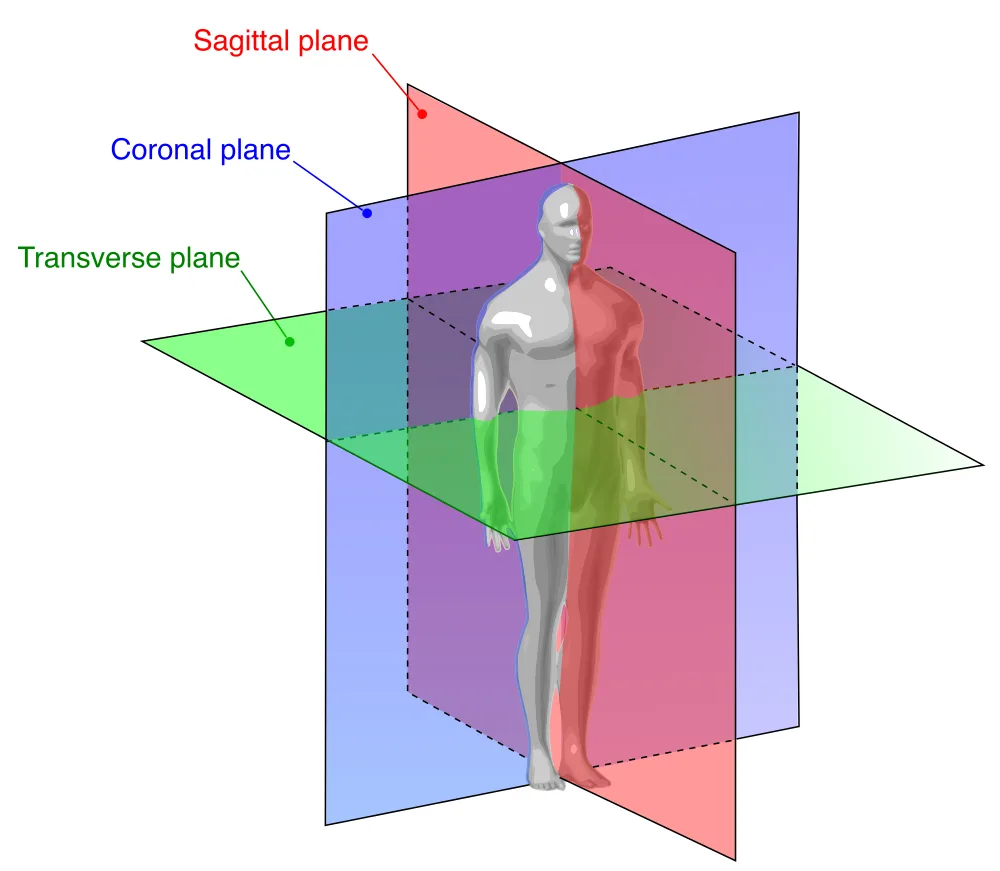
Body planes: sagittal, coronal (frontal) and transverse.
Labeled: sagittal plane, coronal plane, transverse plane.
Image: Human anatomy planes.svg by YassineMrabet, CC BY 3.0. Converted to WebP. Click the image to open it full size.
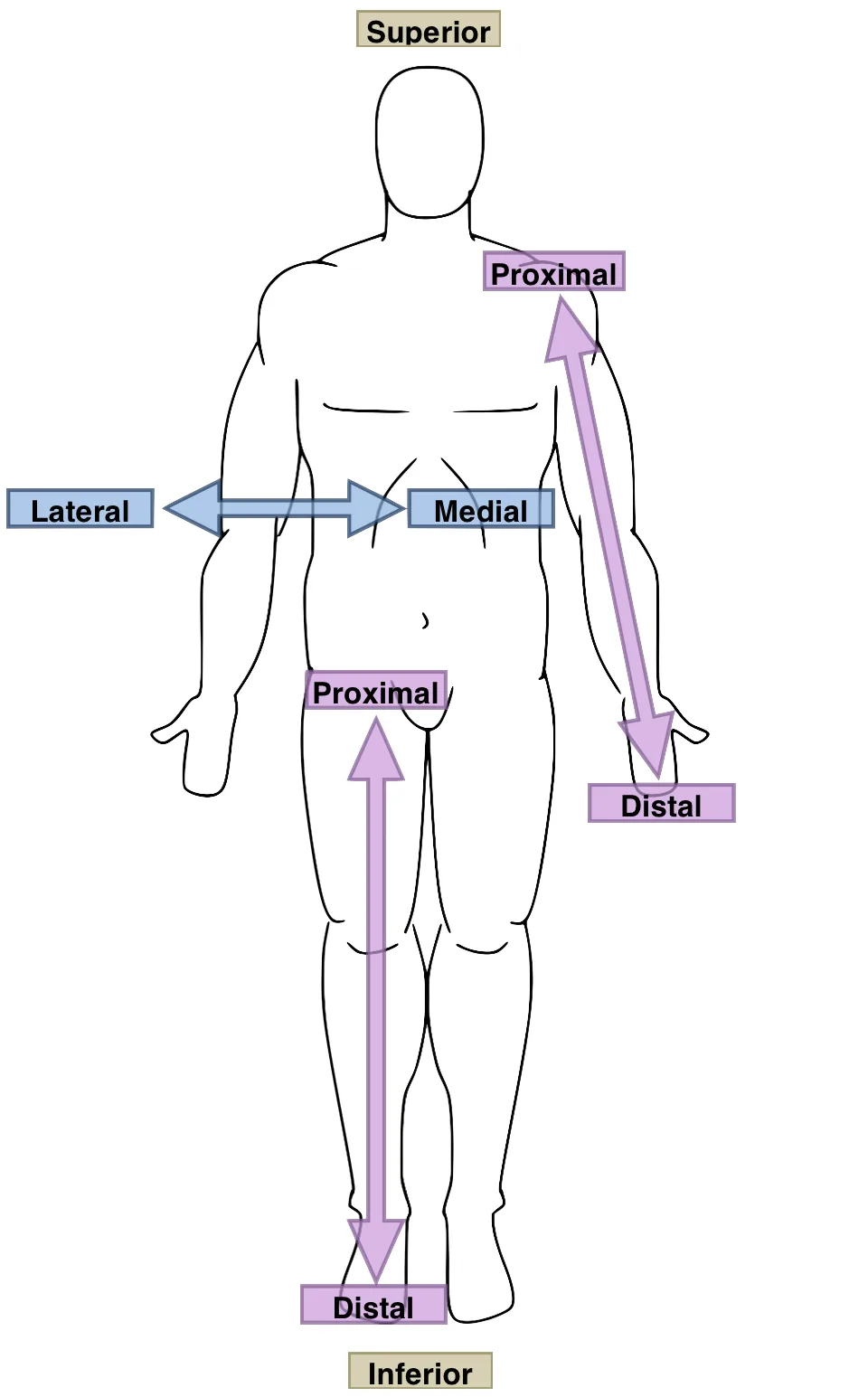
Directional terms: superior and inferior, medial and lateral, proximal and distal.
Labeled: superior, inferior, medial, lateral, proximal, distal.
Image: Anatomical Directions.png by Osteomyoamare, CC BY 3.0. Converted to WebP. Click the image to open it full size.
About these questions
The questions were generated with PDFStudy from anatomy study material, then checked question by question against OpenStax Anatomy and Physiology 2e, a free peer-reviewed textbook: wrong or ambiguous items were corrected or removed, and repeats were dropped. Last reviewed 2026-10-17. Found a mistake? Tell us and we will fix it.
Studying from your own lecture slides or textbook? Upload the PDF and PDFStudy turns it into a quiz like this one, which you can also export to Anki.
More anatomy quizzes
- Skeletal System Quiz (75 questions with answers)
- Muscular System Quiz (93 questions with answers)
- Nervous System Quiz (107 questions with answers)